


Warning Stone: Floyd Shimomura ’73 Preserves Japanese-American History in Winters

By Sue Walther Jones
The photo from 1930 captures a thriving community. Half of the Japanese Americans who lived in and around Winters, California—about 150 men, women, and children—are dressed in their finest for a funeral. They pose in a neighborhood with homes, a general store, other prosperous businesses and a Buddhist temple.
On V-J Day in 1945, it all burned.
Floyd Shimomura ’73 is determined to preserve Japantown’s history and the history of Japanese Americans in Winters. Last year, his efforts, and those of other dedicated local historians, culminated in a ceremony to celebrate a new monument in Winters Rotary Park.

The monument, surrounded by flowers Floyd’s wife Ruth Shimomura and her friends lovingly cultivate, displays the photo and a brief history of Japanese Americans in Winters. Visitors learn that there were Japanese immigrants in Winters before there was a Winters.
“When someone comes to this monument, what I want them to go away thinking is that, wow, the Japanese were here a long time and made a lot of contributions to the Winters economy,” says Floyd. “Many of them here now were born here—third, fourth, maybe even fifth generation.”
“I think that’s real important because it was that notion that you’re a foreigner, that was the reason why all the Japanese were put in camps during World War II and their loyalty was questioned. I mean even for people who were born here, like my father.”
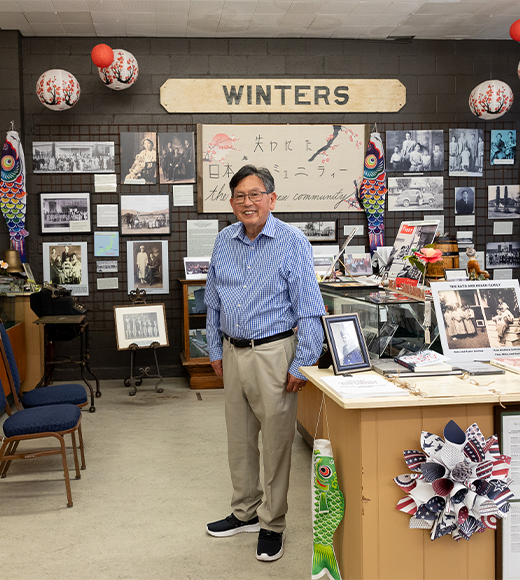
and artifacts gathered for the “Lost Japanese Community of Winters” exhibit.
Floyd grew up in Winters, about 15 miles from UC Davis. He points out that Putah Creek ran near his family’s home and led all the way to campus. As a UC Davis undergraduate, he saw the very first School of Law students walking to their temporary buildings with their briefcases, and decided to become one of them. In the 1980s, he was a professor at King Hall. He and Ruth continue to be extremely involved alumni and generous donors.
Floyd also distinguished himself as a practicing attorney and judge. He held senior positions with the state Attorney General’s Office, Personnel Board, and Department of Finance before becoming an administrative law judge for the California Office of Administrative Hearings.
At the same time, Floyd’s successful efforts for Redress—the federal government’s reparations and formal apology to Japanese Americans incarcerated during World War II—secured his place in Japanese-American history. That history is inseparable from the history of Winters.
The First Japanese Farmworkers in the U.S.
Japanese farmworkers first came to Winters in 1888, 10 years before the city was incorporated. They were the first recorded Japanese immigrants to work in United States agriculture.
They came to the Winters and Vacaville area from San Francisco, where they had worked as “houseboys” while taking classes in the English language and American culture. One of their tasks was to buy food at the local market, where they met Chinese farmworkers who brought produce from the Sacramento Valley and told them about job opportunities. This was just a few years after the Chinese Exclusion Act had cut off immigration from China.
When the Japanese workers first arrived, the block that would be called Japantown by 1923, Block 4, was still called Chinatown. By 1895, the Winters-Vacaville area had the third-largest Japanese population in the U.S. (after San Francisco and Sacramento). Floyd’s grandmother’s family came to Winters in 1898. Her father ran a boarding house near where the city’s historic railroad bridge was built in 1906. Floyd’s grandfather crossed that bridge into Winters the same year. Fortuitously, he needed a place to stay.
It didn’t take long for the prejudice that had excluded Chinese immigrants to extend to the Japanese. The Gentlemen’s Agreement of 1907 stopped further immigration of Japanese laborers to the U.S., but did allow immigrants already in the country to bring over wives and children. California law prohibited Japanese immigrants from owning property or marrying outside their race.
In 1915, the City Council voted to segregate Winters. While Japanese immigrants still lived on farms outside town, within city limits they were restricted to living and doing business only in Block 4. The boarding house was just outside Block 4, so Floyd’s great-grandfather had to give it up.
Japanese immigrants, Issei, could not become naturalized citizens, but their children born in the U.S., Nisei, were citizens. Around 1929, the Nisei were reaching their 21st birthdays, and had every right to own property—and form a corporation to create a Japanese School in Winters. The Japanese-American community borrowed no money to build the school. Unable to buy property, the Issei had saved their money and could afford to make generous donations.
In spite of the prejudice and segregation, the roughly 300 Japanese Americans in and around Winters thrived. Japanese farmworkers had brought traditional pruning techniques with them, making them particularly skilled with fruit trees. Their new way of pruning apricot trees was called the “Winters style.” They raised their children and educated them in their new school. They ran their businesses and attended their temple.
“Home Wasn’t Home Anymore”
On Dec. 7, 1941, the country they had left behind bombed Pearl Harbor. Japanese Americans in Winters had nothing to do with it, but Americans blamed them. President Franklin Roosevelt issued Executive Order 9066, sending all persons of Japanese ancestry on the West Coast to camps. Those from the Winters area went to Amache, Colorado or Gila River, Arizona. Floyd’s family members, including his father, were incarcerated in Colorado.
Holding his grandmother’s documents, Floyd points to her weight: 95 pounds. “She was a very small, petite person, but somehow the government thought that she was a security risk, so they had to put her in a camp. Even though she couldn’t read or write English, and I don’t think she really could read Japanese either,” he says. “It shows how your zero-tolerance policy gets pushed to some absurdity.”
Unable to take much with them, the families scrambled to sell their belongings for next to nothing. They were allowed to store a few things at the Japanese School. The Shimomuras packed a trunk with favorite pots and pans and dress clothes for their return.
Even the Japanese School didn’t last. When Winters High School burned down, local authorities commandeered the school the Japanese community had built. They renamed it Victory High School. Floyd’s parents and other internees continued to subscribe to the Winters Express newspaper in the camps. Floyd’s father read about the fire and wryly remarked, “I guess they can’t blame that on us.” The authorities shipped the Shimomuras’ trunk to them at the camp, where the now useless items took up space in their tiny living quarters. Later, Floyd’s father told him that receiving the trunk made him sad: “Home wasn’t home anymore.”

The trunk (pictured, left) was part of the 2024 “The Lost Japanese Community of Winters” exhibit at the Winters Museum. So was a brick that had been part of the floor of their quarters. Floyd brought it back when he visited the Amache camp to see where his family had been held. Along with it, he brought a piece of barbed wire used to imprison them.
When the war ended in August 1945, Winters held a V-J Day (victory over Japan) celebration on Main Street, a stone’s throw from Japantown. As happened with San Francisco’s V-J Day “Peace Riots,” the Winters gathering descended into violence. No one knows exactly who started the fire that destroyed Japantown, or how. They only remember the spectacle of the raging flames.
The internees read in the Winters Express that Japantown was gone. They read that the City Council and Yolo County supervisors had passed ordinances to keep them from coming home. The federal government encouraged them to resettle on the East Coast or in the Midwest because the West Coast was so hostile. Less than 15% of the former Japanese-American population returned to the Winters area.
At the monument dedication, Floyd told the crowd, “You know, we can think about the negatives, but 15% did come back, because there were some good people here in Winters who went against public opinion and invited the Japanese back to Winters.”
The Shimomuras’ “good people” were the Tufts family. Dr. Warren Tufts chaired the Pomology Division at UC Davis. He was an expert on pruning fruit trees. He invited the Shimomuras to live and work on his family’s farm.
Because of the Tufts family, Floyd, born in 1948, was able to grow up in the community where his family had first lived in 1898. He was able to stand in the shadow of the bridge his grandfather had crossed in 1906. He was able to follow nearby Putah Creek to UC Davis.
“Tell Him to Sign the Redress Bills”
The year Floyd graduated from King Hall, 1973, he joined the Japanese American Citizens League (JACL). In 1982, as the JACL pushed for Redress, he was elected its national president. He was only 34, or about 20 years younger than the other leaders, and the first person from the Sansei (third generation) to become president.
Floyd had the legal skills the movement needed. He testified before Congress. He met with President Ronald Reagan’s domestic policy advisor. He drafted the national JACL’s resolution and wrote its legal brief for the Redress Commission before the bill went to Congress. Floyd’s JACL Redress papers now live in the Smithsonian Institution’s permanent archives.
Floyd even discussed Redress with Japanese Prime Minister Yasuhiro Nakasone when he visited him in Tokyo. Reagan was about to become the first U.S. president to speak before the Japanese parliament. Nakasone told Floyd that Reagan was going to stay at his home and asked if there was anything he would like him to tell the president. Floyd said, “Tell him to sign the Redress bills.” According to Reagan’s presidential papers, Nakasone did ask, as a favor from “one good friend to another.”
With the Civil Liberties Act of 1988, the U.S. federal government apologized and granted reparations to the Japanese Americans who had been unjustly incarcerated.
Placing a Warning Stone
A few years ago, Floyd ran into a high school friend, Rob Coman, at the Yolo County Archives. They were both interested in the history of Japanese Americans in Winters, so they talked to other friends like Dennis Hiramatsu and Howard Kato and to the Historical Society of Winters.
The subsequent Winters Museum exhibit turned out to be more successful than expected. Former residents came to see it and volunteered additional photos. Donations actually became a problem; they ended up with more money than needed. The Historical Society’s board decided they should use the extra funds to honor the Japanese community with a monument in Rotary Park, where Japantown once stood.

When asked why Winters needed the monument, Floyd describes visiting Japan after the 2011 earthquake, tsunami, and Fukushima nuclear accident. “These earthquakes and tsunamis happen not every year or every five years, but it might be 50 years or 100 years apart. So by the time the people who live up there, who live by the ocean, grow up, they forget about the fact that tsunamis do happen.”
He continues, “When I was up there, there were a few places that had these big stones, and they called them warning stones, that marked the highest place that the tsunami had ever reached. Because when the water comes in, it kind of gets funneled in, and so something that may be three feet tall, when it hits the beach it becomes 30 feet tall because the valley narrows as it goes up. So they would put a big stone to mark the highest water level, and on it they would write, ‘Beyond this point, do not build.’
“Our monument is like a warning stone. Normally our political process runs in a relatively narrow band, but, every once in a while, things get out of hand. I think there’s a consensus that what happened during World War II to Japanese Americans was one of those instances where this mass tort happened needlessly, and not only needlessly, but was a self-inflicted wound in terms of helping America win the war. You need a warning stone so that future generations will learn from this.”
Rain forced the dedication ceremony inside Winters Community Center. Around 300 people squeezed into its main hall—appropriate to the 300 Japanese Americans who had lived in the Winters area when Japantown flourished. Many attendees were their descendants.
Consul General of Japan Yo Osumi traveled from San Francisco to speak. Winters Mayor Bill Biasi and Yolo County Supervisor Lucas Frerichs gave remarks. Only very recently had the City Council and Board of Supervisors both, finally, formally rescinded their ordinances rejecting Japanese Americans after World War II. Proclamations from Congress and the state Assembly were delivered. Dennis Hiramatsu, Howard Kato, Rob Coman’s granddaughter Vasey, and other community members spoke.

During his speech, Floyd told the crowd about the role of Japanese Americans in Winters and the city’s role in Japanese-American history. He looked out at the descendants and imagined if the people in the photo could see them. He thanked the “good people” who had helped them, including the Tufts family, who were in attendance and had been very supportive of the monument campaign. He modestly described his own role in passing Redress.
After telling the history, Floyd said, “It seems to me that this little town of Winters has been involved in the struggle as the Japanese attained first-class citizenship from beginning to end, through good times and bad times. And in both instances, in both 1888 and 1988, provided some leadership to the rest of the country.”
One woman at the ceremony was neither a descendant nor dignitary. Floyd’s Aunt Harumi is the last survivor from the 1930 photograph. In the photo, she is 3 years old, being carried by her mother Sawano Shimomura and looking very serious. At the ceremony, now 98 years old, she stood for the crowd to applaud and honor her.
She was beaming.