


'Supreme Court Year in Review' panel assesses cases, nominee Kavanaugh
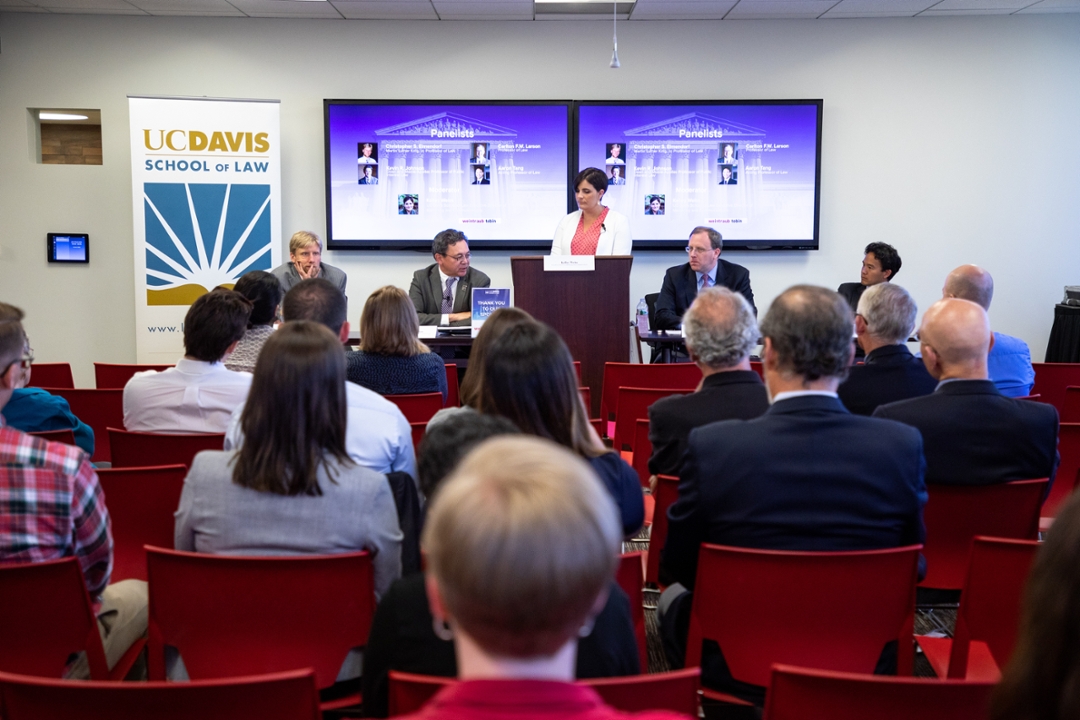 UC Davis School of Law’s "Supreme Court Year in Review" panel discussion, long scheduled to occur on Tuesday, July 10, gained new urgency when President Trump announced the night before that he had tapped Brett Kavanaugh to replace retiring Justice Anthony M. Kennedy.
The event, held at the Weintraub Tobin law firm in downtown Sacramento, began with moderator Kelley Weiss, UC Davis School of Law executive director of marketing and communications, asking the panel, composed of Dean Kevin R. Johnson and Professors Chris Elmendorf, Carlton F.W. Larson and Aaron Tang, to offer assessments of Kavanaugh.
“He is a very conventional pick,” Johnson said of Kavanaugh, a U.S. Court of Appeals for the D.C. Circuit judge and former Kennedy clerk with strong Republican roots. “Given his record and his credentials, and the apparent comfort that conventional Republican leaders have with him, I have a hard time seeing much of a problem in the confirmation process.”
“We should be grateful that Trump is choosing credentialed judges instead of personal loyalists,” Elmendorf said. He noted how Trump has expressed displeasure when Attorney General Jeff Sessions has not fallen in line with Trump’s wishes, such as when Sessions recused himself from the Robert Mueller investigation.
Larson pointed out that it is unlikely Kavanaugh, who served as White House counsel and staff secretary for President George W. Bush, voted for Trump, given his closeness with the Bush family and the Bushes’ famous rift with Trump.
Since Justice Kennedy announced his retirement at the end of the 2017-18 Supreme Court term in June, many have worried that a reconfigured court, minus a Kennedy swing vote that sometimes favored progressive issues, will be staunchly conservative. But the past term showed the court is practically there already, Larson said.
It was “a phenomenal, wonderful term if you are a conservative, and the term from hell if you are a liberal,” he said. “Essentially every big case went the conservatives’ way, culminating in Justice Kennedy’s retirement.”
Kennedy joined or led the majority in key conservative-leaning decisions, including those in Janus v. AFSCME, which delivered a severe blow to public-sector unions; Masterpiece Cakeshop v. Colorado, in which the court sided with a baker who refused to make a wedding cake for a gay couple; and Trump v. Hawaii, in which the court upheld Trump’s travel ban restricting entry into the United States by people from seven, mostly majority-Muslim countries.
Johnson, the panel’s immigration expert, predicted Trump v. Hawaii will have little lasting impact on immigration policy: “Although it got the most attention of all the immigration cases, I think it is the least representative case of where immigration law is going.”
A third iteration of Trump’s so-called “Muslim ban,” the ban weighed in Trump v. Hawaii had been amended to include two countries that are not Muslim-majority and to emphasize a lack of proper travel screening practices within the countries involved.
The court “looked to consider whether the travel ban had a rational purpose - whether it was related to a legitimate governmental purpose,” and found it was, Johnson said. “That sounds like a very narrow review, very deferential to the president. … But in immigration law, there often are cases where the Supreme Court has said ‘We will not review at all, in the immigration realm, the actions of the president or the actions of Congress.’”
More telling, Johnson said, was February’s Jennings v. Rodriguez decision, in which the court ruled immigrants do not have the right to periodic bond hearings while in detention.
The decision reversed a United States Court of Appeals for the Ninth Circuit ruling, but sent the case back to the Ninth Circuit with two questions unresolved - whether indefinite detention without a chance for bail is unconstitutional, and whether a challenge to no-bail provision can be brought as a class action, rather than through individual cases.
“Jennings is critically important because it involves the constitutionality of migrant detention,” Johnson said, noting how migrant detention -- and specifically the separation of minors from their parents -- has dominated the national conversation for the past few months. “This is going to continue to be an issue because it is a tool being used aggressively by the (Trump) administration, and it has been used by past administrations as well.”
Individual liberty scored a victory late in the 2017-18 term, when the Supreme Court ruled, in Carpenter v. United States, that the government needs a warrant to access a person’s cell-phone location history.
The decision indicates that “these detailed records of where we have been are so private in their nature, and so revealing of some of our innermost thoughts, that (they) in fact trigger a reasonable expectation of privacy,” Tang said.
The ruling holds that seeking cell-phone location history constitutes a search under the Fourth Amendment, so the government needs probable cause. “This is where progressives say this is this is a good thing – more privacy rights,” Tang said.
Kennedy’s vote did not swing the progressive way here, either.
“Justice Kennedy was in the minority - he wanted the government to search,” Tang said. “His retirement has no impact on this area of the law.”