


Professor Harris Delivers Lecture in Honor of the Boochever and Bird Endowed Chair
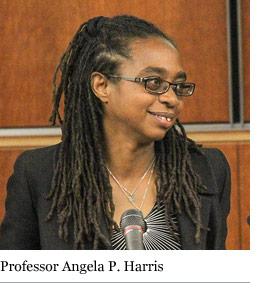 Professor Angela P. Harris delivered a special Lecture in Honor of the Boochever and Bird Endowed Chair for the Study and Teaching of Freedom and Equality at King Hall on April 14. Harris, who was named as new Boochever and Bird chair holder in 2015, spoke on "Food, Farming, and Freedom: Law and the New Black Agrarianism" to a large Kalmanovitz Appellate Courtroom audience that included an outstanding turnout of King Hall faculty.
In his brief introduction, Dean Kevin R. Johnson provided background on the Boochever and Bird chair, explaining that it was established by Charlie Bird '73 and his wife Charlotte in honor of federal judge and Alaska Supreme Court Justice Robert Boochever and Bird's parents. Previously held by Professors Cruz Reynoso and Allen Brownstein, the chair supports faculty research and teaching designed to preserve and expand the virtues of freedom and equality.
Harris, one of the nation's foremost scholars in the fields of critical race theory, feminist legal theory, and civil rights, said she was "extremely honored to follow in the footsteps" of Professors Reynoso and Brownstein and extended a "heartfelt thank you" to Charlie Bird for establishing the chair and to her King Hall colleagues for appointing her. Her talk concerned her study of Black urban farmers and gardeners in the San Francisco Bay Area and how their vision compares and contrasts with ideas of freedom expressed by Thomas Jefferson, the Civil Rights paradigm, and the Black Lives Matter campaign.
Harris said that the values of equality and inclusion espoused by leaders of the Civil Rights movement are "only one thread in the social movements of people of color in the United States, and the second thread is about freedom." Traditional constitutional definitions of freedom are often "negative" in the sense that they describe freedom as the absence of various forms of oppression, but Black urban farmers and gardeners see their work as a path toward a vision of "positive freedom" that is based upon self-determination, said Harris.
"Black Lives Matter articulates a demand for the basic negative freedom not to be arbitrarily killed by your government," said Harris. "The new Black agrarians push further into positive freedom, the freedom to be healthy, to exercise control over what goes into your body, and the freedom and dignity that come with access to the means of survival, not indirectly through the money paid to a third party who controls the food, but directly, through the redistribution of land and water. Both movements, although they are focused on Black people and Black lives as those who are the most vulnerable, are multiracial movements and articulate the human rights that all of us should have."